
my uttarakhand news Bureau
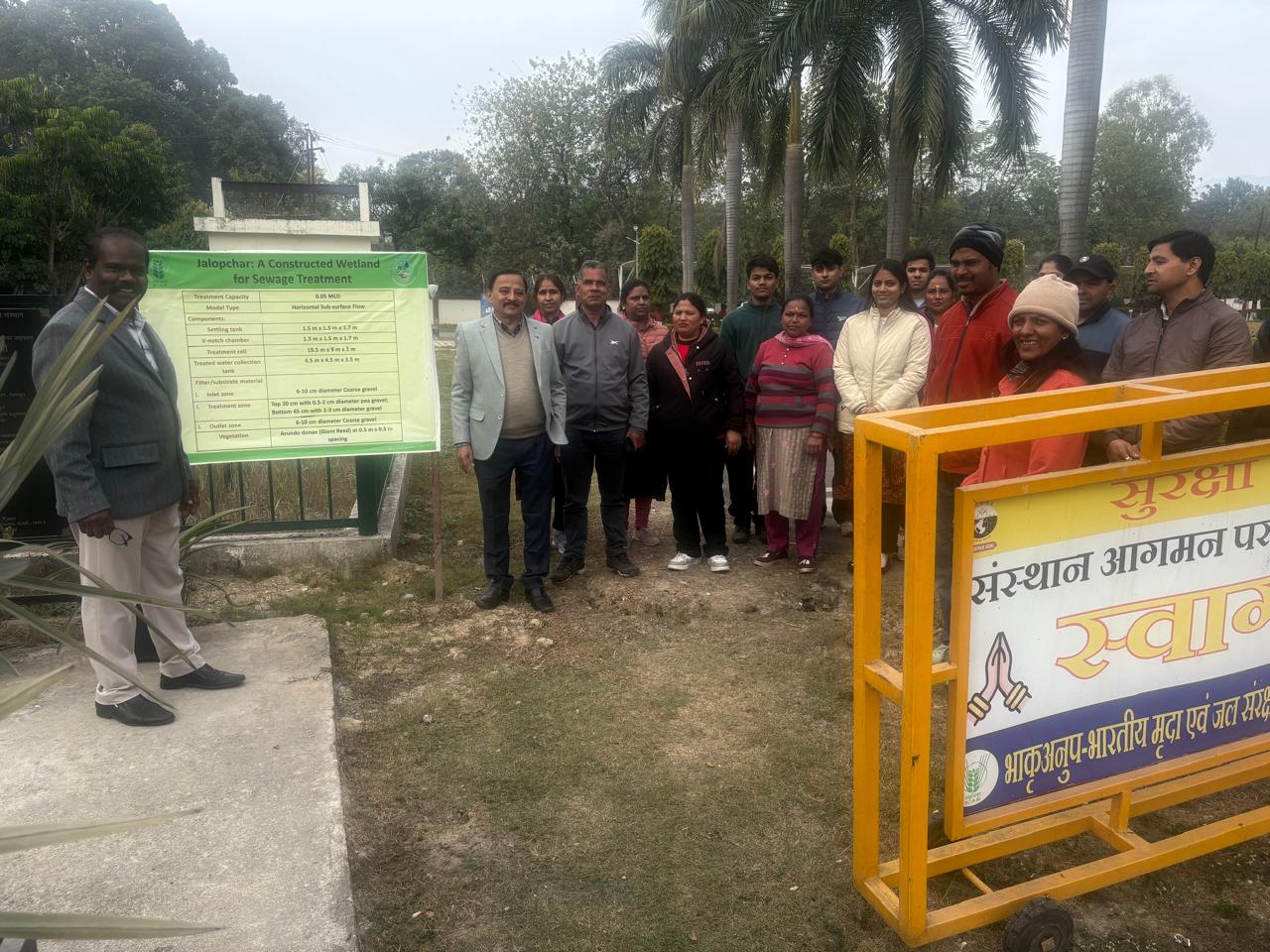
Dehradun, 26 Dec: As part of Swachhta Pakhwada 2025 (December 16–31), the ICAR–Indian Institute of Soil and Water Conservation (ICAR–IISWC), Dehradun organised an Awareness Drive on Wastewater Purification and Recycling for Environmental Cleanliness today at the institute campus.
Dr M Muruganandam, Principal Scientist and Officer-in-Charge (PME & KM Unit), delivered a detailed talk on the importance of water purification, water quality maintenance, wastewater disposal, and recycling for environmental sustainability. He apprised the participants about the “Jalopchar” wastewater treatment system installed in the institute campus for treating wastewater generated from the official residential quarters.
Dr Muruganandam explained that Jalopchar operates on the principle of Plant-Microbe-Media (wastewater)-Sand-Stone Filters Interactions, using nature-based solutions for wastewater treatment. He highlighted the role of plant species such as Typha latifolia and Arundo donax, which help in trapping and removing heavy metals, household chemical pollutants, nitrogenous wastes, and microbial contaminants. He emphasised that the system is eco-friendly as it does not rely on large filters, aerators, or harmful chemicals. He further noted that wastewater filtration and purification systems are continuously evolving with technological advancements and increasing demand for water reuse.
Dr Ramapal elaborated on the key components of the Jalopchar system, including selected macrophytes, layered sand–stone filter media, inlet strainers and filters, water-level monitoring units, and storage tanks designed to receive, hold, treat, and recycle wastewater. She explained the synergistic functioning of plants and microbes in trapping and degrading pollutants, noting that treatment efficiency depends on the plant species used and the microbial population present in the system.
Dr Sadikul Islam, Scientist; Anil K Chauhan, Chief Technical Officer; TS Rawat, Finance & Accounts Officer; Brajesh Jadon, Administrative Officer; Alok Khandelwal, Assistant Administrative Officer; along with staff members of the institute and residents of Soil Colony, actively participated in the programme.
The programme was coordinated by Dr M Muruganandam, with support from Dr Ramapal, Anil K Chauhan, TS Rawat, and Jordon of ICAR–IISWC. About 45 participants, including institute scientists, technical and housekeeping staff, trainee students, and residents of Soil Colony, attended the programme.
The awareness drive significantly enhanced participants’ understanding of water quality, wastewater treatment technologies, and water recycling practices, contributing to improved awareness on addressing water scarcity and sustainable wastewater management.
About The Author