
By Dr Dipikka Kapoor
Tehri, 3 Mar: As Uttarakhand prepares to host the Tehri Lake Festival from 6 to 9 March at Tehri Lake, the world will witness adventure sports, cultural programmes, and a vibrant celebration of tourism growth in our Himalayan state.
Kayaks will glide across shimmering waters. Music will echo through the mountains. Visitors will see a destination rising steadily on the global tourism map.
But beneath those sparkling waters lies a story that deserves remembrance.
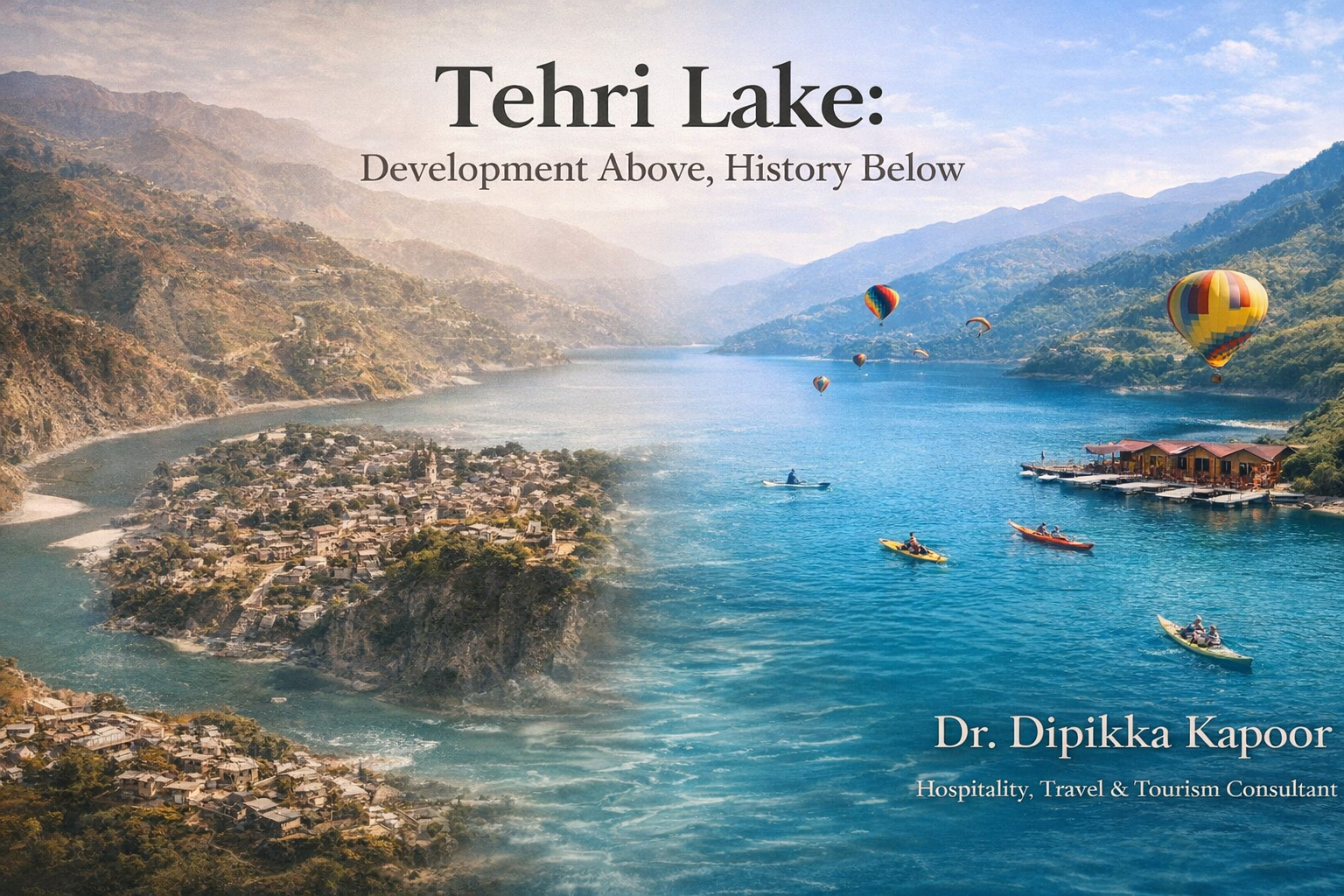
Before it became a lake, this was Old Tehri — a vibrant township situated at the sacred confluence of the Bhagirathi and Bhilangana rivers. Nestled amid the Himalayan ranges and overlooking the Chamba hills, it served as the historic capital of the princely state of Tehri Garhwal.
Founded in 1815 by King Sudarshan Shah after the end of Gorkha rule, Tehri carried royal heritage and deep cultural roots. But beyond history, it carried life.
It was a complete town in every sense. Schools and colleges shaped young minds. Temples, a Gurudwara, and a mosque reflected harmony. Markets bustled with vegetables, grains, clothing, and building materials. There were cinema halls, playgrounds, courts, municipal offices, and a state bus depot.
Everything needed for daily life existed within its closely knit neighbourhoods.
Families lived with warmth and trust. Doors were rarely locked. Festivals were shared. Childhood meant running through familiar lanes and knowing every face in the market.
Then came change.
The construction of the Tehri Dam began in 1978 as a visionary step toward hydroelectric power and national development. Large-scale rehabilitation and relocation of families took place primarily between 2001 and 2004. By 2004, as the reservoir began filling, Old Tehri gradually submerged beneath the rising waters. The dam was formally commissioned in 2006, strengthening India’s energy capacity and infrastructure growth.
The project brought electricity, irrigation, and infrastructure growth. It strengthened India’s energy capacity and placed Uttarakhand firmly on the development map.
Today, Tehri Lake fuels tourism, employment, and international recognition. As a proud citizen of Uttarakhand and a hospitality professional, I celebrate this growth wholeheartedly. Tourism empowers communities and showcases our state to the world.
And yet, for some of us, the lake is more than a destination.
It is memory.It is childhood vacations with my grandparents.It is cousins gathering during holidays.It is laughter echoing through a town that no longer exists on the surface.
I have often felt proud seeing the Tehri Lake Festival gaining global attention and uplifting Uttarakhand’s tourism development to greater heights. Yet, I have never gathered the courage to visit the lake. My eyes would search for the town beneath the water, the homes, the streets, the life that is now untraceable.
That is the irony of Tehri.
People come here for celebration.Some of us remember it for separation.
Tehri Lake stands today as a symbol of progress — but also of sacrifice. It reminds us that development reshapes geography, while memory reshapes the heart.
As we celebrate the Tehri Lake Festival 2026, may we honour both, the shining waters above and the silent city below.
Because true progress does not forget where it began
“Some cities are not lost. They live beneath the surface.”
(The author is a Hospitality, Travel & Tourism Consultant.)
About The Author