
Lecture on Indian knowledge tradition and communication held at Doon University
my uttarakhand news Bureau
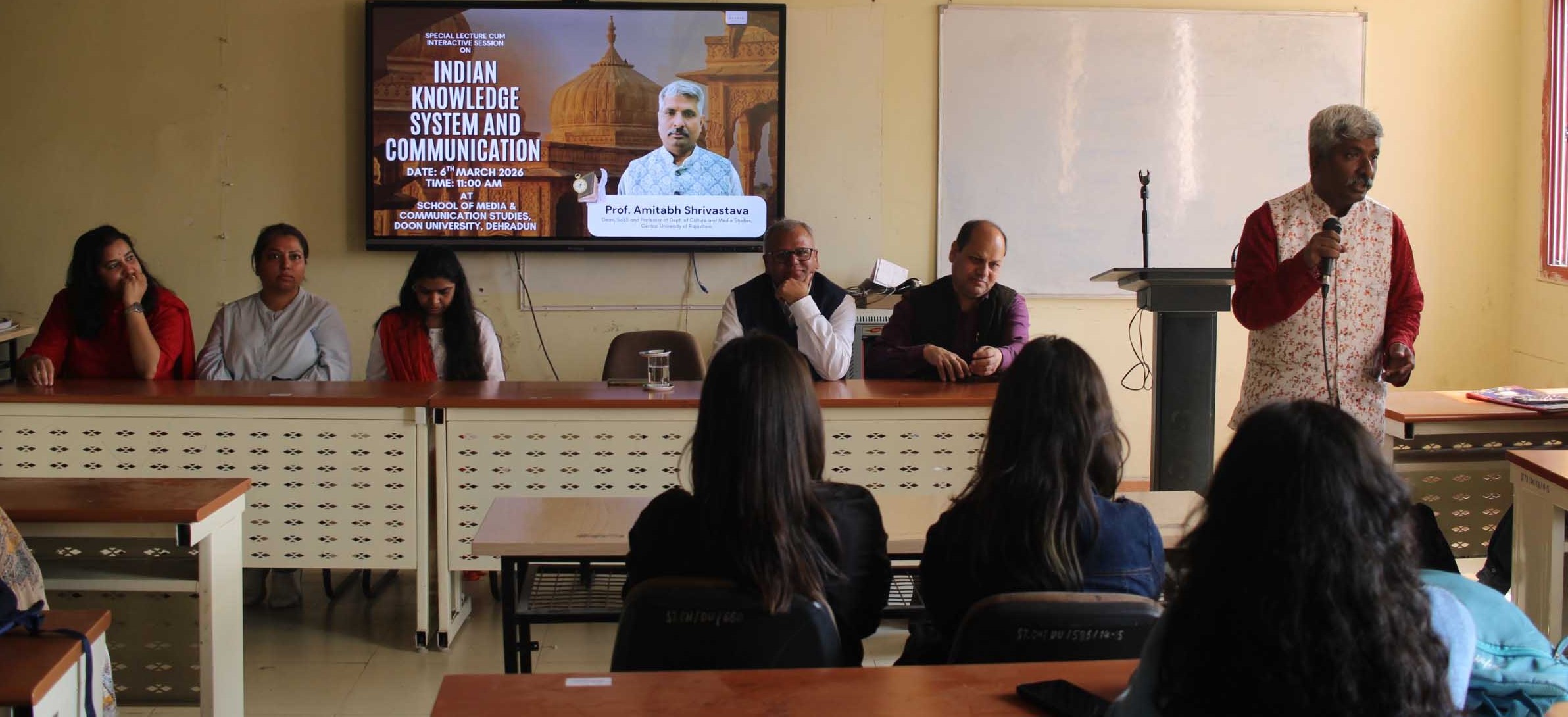
Dehradun, 6 Mar: A lecture on Indian Knowledge Tradition was delivered at the School of Media and Communication Studies of Doon University today by Amitabh Shrivastava, Dean of the Culture and Media Studies Department at Central University of Rajasthan. The lecture focused on the relevance of India’s intellectual traditions in modern communication practices and emphasised the importance of understanding cultural identity in an increasingly globalised world.
Addressing the students and faculty members, Shrivastava elaborated on the concept of ‘self’ and its significance in shaping individual identity and intellectual growth. He encouraged students to recognise the value of their own cultural and philosophical roots and to set clear goals for establishing a distinct Indian identity on the global stage. According to him, the strength of Indian civilisation lies in its long-standing knowledge traditions, which continue to influence various aspects of global discourse, including media, literature and storytelling.
A memento was presented to Shrivastava by Rajesh Kumar, Head of the Department at the School of Media and Communication Studies. In his welcome address, Kumar highlighted the fundamental principle of ‘Sahridayata’ as described in the ancient text ‘Natyashastra’. He said that the idea of emotional and intellectual sensitivity embedded in Indian aesthetic theory has deep relevance even in contemporary communication practices.
Kumar also emphasised the need to incorporate the various communication theories rooted in Indian knowledge traditions into global academic discourse. He noted that Indian philosophical thought and traditional forms of communication provide a rich intellectual foundation that can contribute significantly to modern media studies. According to him, universities and academic institutions must play an active role in ensuring that these indigenous perspectives receive appropriate recognition at the international level.
In his detailed lecture, Shrivastava discussed multiple dimensions of Indian knowledge traditions and their continuing relevance in contemporary society. He explained that communication as a discipline has evolved considerably over time due to technological developments and changing societal structures. However, he said that the philosophical foundations of communication can be traced back to ancient Indian texts and traditions, which placed strong emphasis on dialogue, narrative and shared understanding.
Shrivastava observed that communication media have undergone dramatic transformations with the advent of digital technologies and social platforms, which have reshaped the way information is produced, disseminated and consumed. These changes, he said, have also altered the social landscape by creating new forms of cultural exchange and interaction. Despite these changes, he stressed that the core values embedded in Indian traditions remain relevant and continue to provide guidance in understanding human relationships and social communication.
He further remarked that Indian traditions represent the cultural roots of the country and that it is essential for younger generations to remain connected with these roots. According to him, maintaining this connection not only strengthens cultural identity but also enables individuals to contribute meaningfully to global intellectual debates.
Shrivastava also emphasised the role of academic institutions in preserving and promoting indigenous knowledge systems. He said universities must not only document and analyse these traditions but also reinterpret them in the context of contemporary challenges. Such efforts, he said, would help bridge the gap between traditional wisdom and modern knowledge frameworks.
The lecture was attended by faculty members and students of the School of Media and Communication Studies. Harsh Dobhal and other faculty members of the department were present during the programme. Assistant professors Karuna Sharma, Juhi Prasad, Abshar Abbasi, Vandana Nautiyal and Sargam Mehra also attended the session along with a large number of students.
The interactive session that followed the lecture provided an opportunity for students to engage directly with the speaker and discuss various aspects of Indian knowledge traditions, communication theory and their application in contemporary media practices.
About The Author