
Cong questions Govt’s Human Development claims in U’khand
my uttarakhand news Bureau
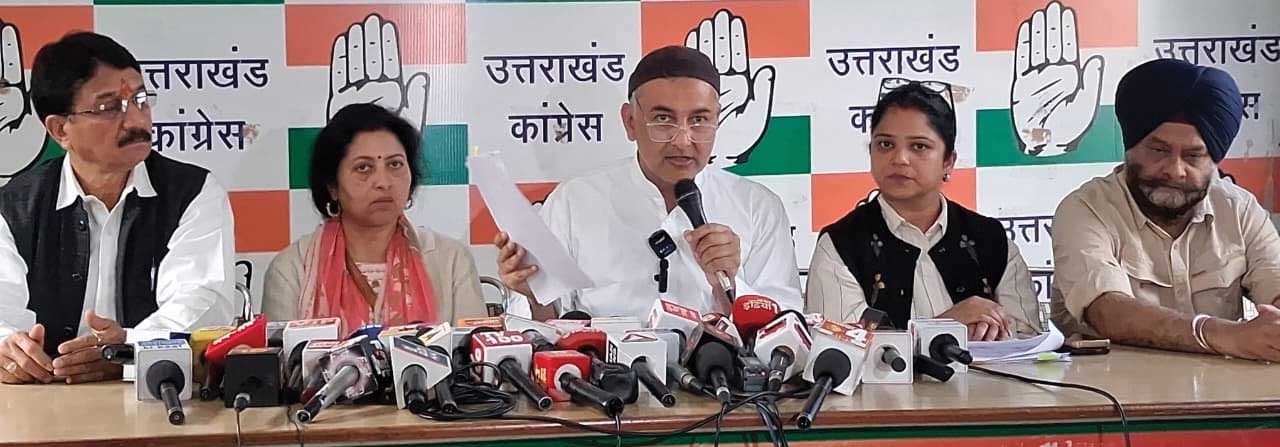
Dehradun, 6 Mar: Uttarakhand Congress today launched a sharp attack on the Bharatiya Janata Party (BJP) over the celebrations being organised to mark four years of the Uttarakhand government. National Secretary of Congress and MLA from Manglaur (Haridwar), Qazi Nizamuddin today addressed a press conference at the Congress State Headquarters here, at which he alleged that the ruling party is attempting to project achievements that do not reflect the ground reality in the state.
Nizamuddin said that while the government is making tall claims regarding improvements in the Human Development Index, the actual situation in the state paints a very different picture. He pointed out that even as the government highlights development indicators, environmental and social conditions in the state are deteriorating.
Referring to the environmental situation, he said that the air quality in Dehradun has been steadily worsening over the years. According to him, the Air Quality Index in 2018 had crossed 604, reflecting the alarming level of pollution in the city. He observed that senior officials, ministers and legislators themselves do not drink water without filtration, yet the government continues to make grand claims about human development. Nizamuddin said it is unfortunate that the government is hesitant to present the true situation before the public.
Citing official data, the Congress leader said that figures released by the Union Home Ministry for 2023, which came into the public domain in September 2025, show that Uttarakhand has one of the most unfavourable sex ratios at birth among Indian states. According to the data, there are only 868 women for every 1,000 men in the state. He said these figures have been issued by the Union Home Ministry and therefore cannot be denied by the state government.
Nizamuddin further questioned the government’s claims regarding the strength of the state’s economy. He said that, if the economic indicators presented by the government are truly strong, migration from rural areas should have stopped by now. The continued migration of people from villages, he said, clearly indicates that the figures being presented by the government do not reflect the actual situation on the ground.
Presenting what he claimed as factual data, Nizamuddin said that during the Congress government in 2016-17, the state had 12,601 primary schools. By 2025 this number has reduced to 11,116. He said the number of upper primary schools, which earlier stood at 2,889, has sharply declined and only around 2,500 now remain. Similarly, the number of secondary schools has dropped from 1,100 to 921. Overall, he said, the total number of schools in the state stood at 17,753 in 2017 but has now declined to 16,018. He added that these are official figures provided by the government in reply to Question No 1436 in the Lok Sabha on 9 February, 2026.
The Congress MLA alleged that the expenditure on social sectors such as education, health and development, which was at a higher level during the Congress government, has now declined to around 40 per cent. He said these figures belong to the so-called double-engine government that repeatedly speaks about the slogan of “Sabka Saath, Sabka Vikas”.
Nizamuddin referred to the government’s claim that the per capita income in Uttarakhand is Rs 2.73 lakhs annually, which implies that an average individual earns around Rs 23,000 to Rs 24,000 per month. However, he said that these figures largely reflect incomes in urban areas where institutions such as AIIMS exist, private sector employment opportunities are available and government officials reside. To understand the real situation, he suggested that one should visit districts such as Pithoragarh, Almora, Bageshwar or areas like Khanpur and Narsan and verify whether people there actually earn Rs 23,000 to Rs 24,000 per month.
Highlighting the industrial scenario, Nizamuddin alleged that due to lack of investment in the past decade the number of factories in the state has declined, which in turn has reduced employment opportunities. In 2017 there were 2,987 factories in the state, whereas the number has now declined to 2,897, indicating a reduction of 90 units. He claimed that employment in these factories has also declined from 80,967 workers in 2017 to 77,001 in 2024, a reduction of 3,966 jobs. Similarly, the number of sugar mills in the state has come down from 10 in 2017 to seven at present.
Referring to health indicators, Nizamuddin said that while the BJP government speaks about social justice and development, the National Health Report indicates a worrying situation in Uttarakhand. According to the report, nearly 59 per cent of children in the state suffer from anaemia, while about 45 per cent of women face deficiency of haemoglobin. In addition, around 27 per cent of children — nearly one in four, are victims of malnutrition.
He also criticised the government for failing to fully utilise the budget allocations for various sectors. According to him, the government could not spend Rs 1,423 crores allocated for social services. Similarly, 27 per cent of the agriculture budget, which was meant to help double farmers’ incomes, remained unutilised. He added that 23 per cent of the funds allocated for village development also remained unused, which, he said, indicates a lack of political will to develop the state.
Citing the Comptroller and Auditor General’s report (CAG report), he said that misgovernance in the health sector infrastructure of the state is clearly visible. Out of 21,670 sanctioned posts in the medical department, about 41 per cent are lying vacant. He added that 54 per cent of posts in the Food and Civil Supplies Department are vacant, while vacancies stand at 45 per cent in the Health and Family Welfare Department and 40 per cent in the Medical Education Department. He also said that there is a shortage of nearly 94 per cent of specialist doctors in community health centres, and a similar situation exists in district and sub-district hospitals.
Criticising the government’s handling of the state budget, Nizamuddin said that while the government presents the budget every year with great fanfare, it fails to explain that nearly 25 per cent of the total budget is spent on interest payments and loan instalments. He said that due to reduced financial assistance from the Centre under the double-engine government, the state has increasingly relied on borrowing to meet its expenditure.
When the Congress left power in 2017, the state’s total debt stood at Rs 44,508 crore, he said. At present, the debt has increased to Rs 108,527 crore, representing an increase of about 144 per cent. He remarked that the government appears to believe in borrowing heavily while projecting prosperity.
Referring to the conduct of the budget session of the state assembly, Nizamuddin alleged that the government does not respect constitutional norms or established rules. He said the Uttarakhand Assembly’s Rules of Procedure and Conduct of Business, 2005, are frequently violated. According to Rule 20, Part 3, at least four days of discussion should take place in the House after the Governor’s address. Rule 172 states that there should be no discussion on the day the general budget is presented. Rule 175 provides that at least four days of general discussion should take place after two days of the budget presentation, while Rule 176 requires that at least 19 days be allocated for discussion and voting on demands for grants in consultation with the Speaker and the Leader of the House.
On this basis, he said, the Assembly session should ideally last between 20 and 25 days.
State Congress general secretary Rajendra Shah, social media adviser Amarjeet Singh, party spokespersons Sujata Paul, Pratima Singh, former servicemen department president Ramratan Negi and Abhinav Thapar were among those present at the press conference.
About The Author