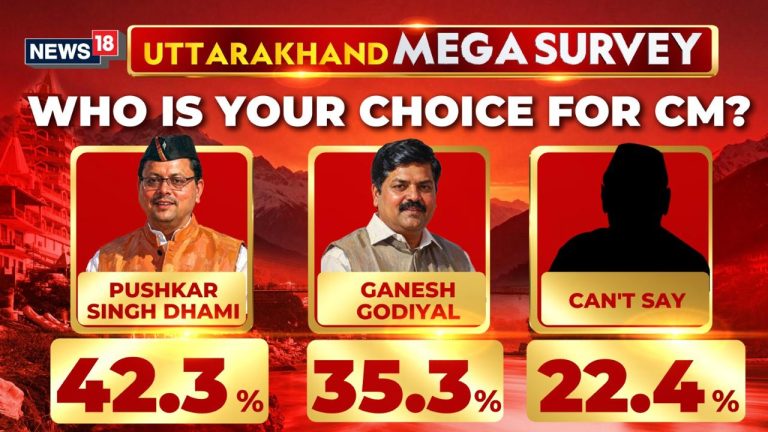
Dhami leads CM preference with 42.3 per cent
my uttarakhand news Bureau
DEHRADUN, 20 Nov: The BJP appears to have a clear advantage as Uttarakhand prepares for the 2027 Assembly elections, with voters expressing considerable confidence in Chief Minister Pushkar Singh Dhami’s governance and leadership, according to the latest News18 Uttarakhand Mega Survey.
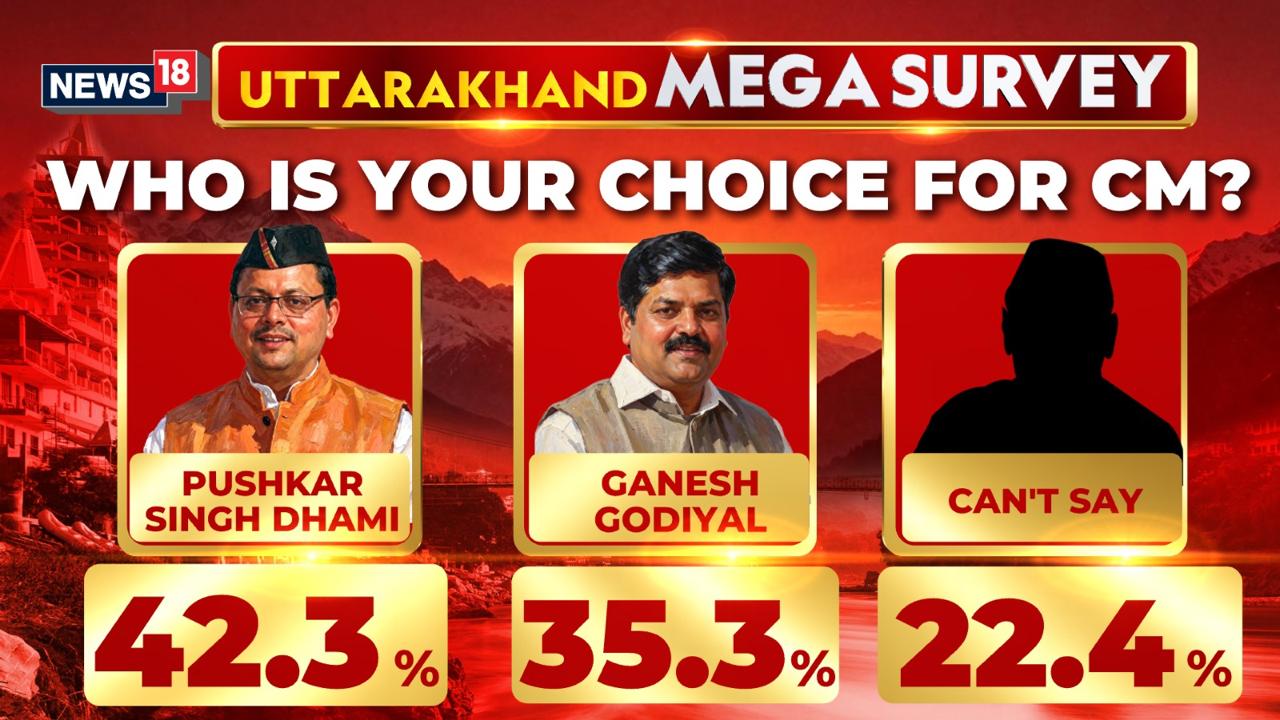
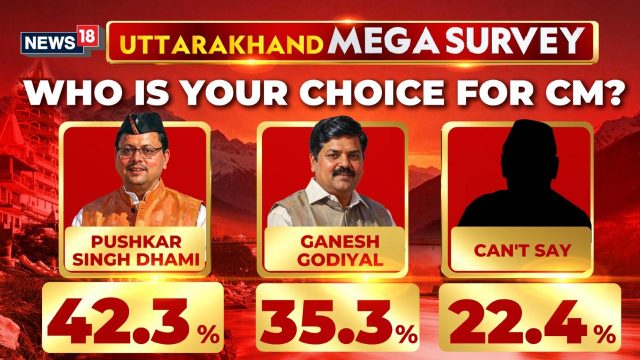
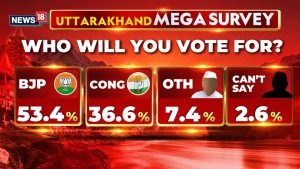
Covering 10,235 respondents across seven selected districts accounting for approximately 80 per cent of the state’s population, the survey puts the BJP’s voting intention at 53.4 per cent against 36.6 per cent for the Congress. As many as 51.2 per cent of respondents expect the BJP to form the next government. Dhami also leads the Chief Minister preference survey with 42.3 per cent support, compared with 35.3 per cent for Congress leader Ganesh Godiyal.
The survey, which seeks to assess voting intentions, voter priorities and issues likely to shape the political discourse, clarifies that its findings do not constitute a prediction of actual election results. It also cautions that constituency-level seat projections cannot be reliably derived from statewide figures alone and that recalled voting patterns are subject to recall errors.
The findings indicate broadly favourable perceptions of the Dhami government’s performance, with 62.6 per cent of respondents expressing satisfaction with its overall functioning. Satisfaction is relatively higher regarding law and order, women’s safety, infrastructure development, farmer support and tourism initiatives.
The BJP also enjoys considerable political ownership of Uttarakhand’s religious and cultural heritage, with 63.1 per cent identifying it as the party best placed to preserve the state’s heritage. The double-engine development narrative finds support among 52.9 per cent, while 61.1 per cent favour the government’s drive against illegal religious structures and restrictions on land purchases by outsiders.
However, inflation emerges as the biggest electoral concern, cited by 42.9 per cent of respondents, followed by local employment and migration (16.3 per cent), recruitment irregularities and examination paper leaks (12.8 per cent), and corruption (9.4 per cent). These concerns could pose challenges for the ruling party despite its overall favourable performance ratings.
The survey also indicates some erosion in the BJP’s support base. Among respondents recalling voting for the BJP in the 2022 Assembly elections, 14.7 per cent now indicate an intention to vote for the Congress. The corresponding figure among recalled BJP voters in the 2024 Lok Sabha elections is 15.5 per cent. The Ankita Bhandari case may also have electoral implications, with 55.4 per cent of respondents believing that it will influence voting behaviour, although its actual impact remains to be seen.
For the Congress, the survey presents a relatively encouraging picture. Its current voting intention of 36.6 per cent is higher than its recalled support of 30.3 per cent in the 2022 Assembly elections and 33.2 per cent in the 2024 Lok Sabha elections. The party has retained a substantial proportion of its previous voters and is also attracting some respondents who recalled voting for the BJP in the last two elections. However, it continues to trail the BJP by 16.8 percentage points, while its Chief Minister preference figure is seven percentage points below Dhami’s. The challenge for the Congress is to convert anti-incumbency sentiment into a credible and geographically broader political alternative.
The survey also reveals significant regional variations. Garhwal remains substantially BJP-leaning, with the party recording 57 per cent voting intention against 30.7 per cent for the Congress. Kumaon, by contrast, is almost evenly balanced, with the BJP at 47.3 per cent and the Congress at 46.4 per cent. Udham Singh Nagar is particularly favourable to the Congress, while Haridwar remains closely contested. Dehradun and Almora show considerable advantages for the BJP.
Demographic patterns indicate that the BJP is relatively stronger among older respondents, graduates and postgraduates, white-collar employees and business and household segments. The Congress is more competitive among younger voters, those with lower levels of education, landless labourers and unskilled workers. Gender-based and urban-rural variations are comparatively modest.
Overall, the survey suggests that economic concerns, particularly inflation, unemployment, migration, recruitment fairness and corruption, will remain central to the electoral contest. While the BJP will need to reinforce its governance credentials through tangible progress on employment and cost-of-living concerns, the Congress has an opportunity to build its campaign around economic hardship, accountability and fair recruitment, backed by a stronger leadership proposition and effective constituency-level organisation.
About The Author