
By Radhika Nagrath
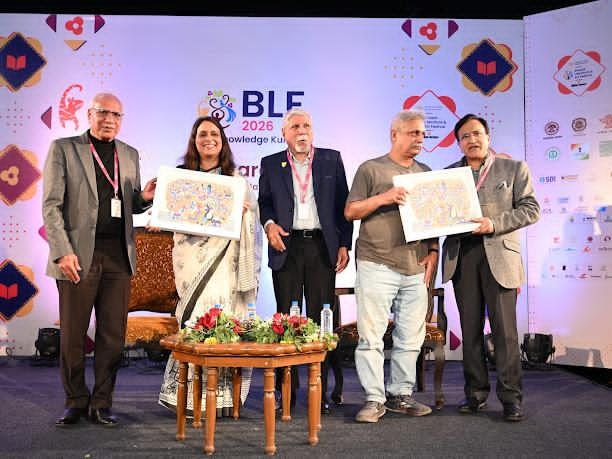
Bhopal, 3 Feb: The three-day Bhopal Literature Festival unfolded here as a confluence of literature, history, public thought and the performing arts. What distinguished the festival was not merely the breadth of its programming but the clarity of its intent, placing ideas at the centre and ensuring seamless execution that allowed conversations to flow, enthralling audiences throughout.
The opening day set the literary tone with sessions that moved between civilisational introspection and cultural memory, both conventional and contemporary. At the Antarang venue, discussions such as decoding Viksit Bharat examined India’s evolving national imagination, while Echoes of Faith: Exploring Nature and Divinity reflected on spirituality as lived experience. History and heritage were foregrounded through conversations on tribal traditions in the session Amazing Tribals of Rajasthan and the launch of India Reborn, which revisited India’s resilience across centuries. Contemporary geopolitics and technology featured prominently in the Geotechnography session, while popular culture found voice in Tumhari Aukaat Kya Hai, a candid and well-received conversation with actor and musician Piyush Mishra. The evening resonated with Dastan-e–Guru Dutt, a poignant tribute to the filmmaker’s life and music, followed by Kavyaraag, where poetry and melody merged in an evocative close.

Besides this, parallel sessions at SBI Rangdarshini expanded the literary canvas with discussions on Booker-winning fiction, wildlife narratives, classical aesthetics through Geet Govind, thriller writing and Gandhian thought in the 21st century. Meanwhile, Gateway Vagarth foregrounded Hindi literature and social discourse, hosting sessions on modern Hindi poetry, women-centric urban narratives, Dalit historiography, entrepreneurship and contemporary socio-cultural questions.
The second day sustained the balance between scholarship and accessibility, with sessions across venues engaging audiences on governance, literature, ecology and emerging social realities. The festival reached a reflective crescendo on the third day, which brought together history, politics, media, philosophy and performance. At Antarang, sessions ranged from children’s literature and body consciousness to geopolitics and military history. An engaging session on how ancient India transformed the world featured historian William Dalrymple in an online dialogue with Raghav Chandra. Discussions on India–China relations, Mughal military history through Raja Man Singh and the pressures of contemporary television journalism added depth and immediacy. Poetry and philosophy provided moments of pause through Zameen se Aasaan Tak, while Daastan-e–Shankar, narrating the life of Adi Shankaracharya, offered a contemplative close ahead of the valedictory ceremony and awards.
The final day featured an eclectic mix, from time travel adventures with young prodigy Vaishnavi Anantha to sessions on civil services, ecological crises, global literature and the visual arts. Folk Tales from the Himalayas, featuring Mona Verma in conversation with Vinita Dhondiyal Bhatnagar, highlighted the power of oral traditions and regional storytelling, reaffirming the festival’s commitment to diverse voices. Alongside, conversations on culture and society, women in leadership, constitutional values, cybersecurity, counter-terrorism narratives, contemporary Indian cinema and governance showcased a constant dialogue with society.
The precisely curated festival by Raghav Chandra focused on lucid intellectual experiences and compelling art forms. It concluded with audiences applauding the military precision of Raghav Chandra, President of the Society for Culture and Environment, along with Abhilash Khandekar, Meenakshi Dua, Meera Dass, Niharika Singh, Rima Hooja, Brig Sanjay Agarwal and Sulakshna Chaudhary, whose collective efforts ensured the festival’s success.
About The Author