By Arun Pratap SinghGarhwal Post Bureau
Dehradun, 5 Feb: The Uttarakhand government has set up the Uttarakhand State Minority Education Authority which is aimed to replace and abolish the Uttarakhand Madrasa Board from July this year. Uttarakhand is the first state to abolish the Madrasa Board of Education and it is being claimed that this step is likely to be replicated by some of the other BJP ruled states in the country. Sources in the BJP claim that this is yet another major policy intervention by the BJP led government after the implementation of the Uniform Civil Code (UCC) by the Uttarakhand Government.
In addition, the PM Narendra Modi led BJP Government had also implemented a new law banning instant Triple Talaq, which is considered to be a major reform aimed at protecting the rights of married Muslim women.
It may be reminded here that Pushkar Singh Dhami government has decided to dismantle the existing madrasa education framework and place all minority educational institutions under the umbrella of the newly constituted Uttarakhand State Minority Education Authority, a move the government claims will reform the education system and impart nationalist and nationally aligned education to minority students.
Under the new arrangement, all the madrasas and the minority-run educational institutions operating in the state will cease to exist in their present form. From the upcoming academic session, these institutions will be required to follow a curriculum prescribed by the Minority Education Authority and obtain mandatory recognition from the Uttarakhand Board of School Education. The government has asserted that registration under the Authority has been made mandatory so that these institutions can legitimately access government financial assistance, scholarships and welfare schemes. With this decision, institutions functioning under the name of madrasa will no longer operate independently in the state and instead would have to operate under regulations of the new Uttarakhand State Minority Education Authority.
The Dhami government has claimed that the decision has been necessitated by the discovery of hundreds of madrasas operating without government approval across the state. In many cases these included cases where children from other states were also being brought in to study. In Haridwar district, several madrasas were found where Hindu children were reportedly being imparted Islamic religious instruction, a matter that drew the attention of the National Commission for Protection of Child Rights (NCPR), which subsequently sought explanations from senior state officials. Acting on these findings, the state government sealed 227 illegal madrasas across the state. During verification, serious questions had also emerged regarding their funding sources and the credentials of their operators, prompting the government to re-assess the entire madrasa system.
It may be recalled that, following these developments, Chief Minister Pushkar Singh Dhami had placed a proposal before the Cabinet to abolish the Madrasa Board. The decision was subsequently passed by the state Assembly and received the assent of the Governor, clearing the way for the introduction of what the government has described as a new nationalist education system for the children belonging to the minority communities in the state.
The government has already announced the formation of a 12-member Uttarakhand State Minority Education Authority. Professor Surjit Singh Gandhi, a member of the Sikh community and an expert in economic affairs, has been appointed as its Chairperson. The Authority includes representation from various minority communities, with two Muslim professors from Soban Singh Jeena University, Almora, including Syed Ali Hamid and Robina Aman. Other members include Dr Rakesh Jain from the Jain community, Alba from the Christian community, Pema Tenzin representing Buddhists, and Gurmeet Singh from the Sikh community. Social worker Rajendra Bisht and retired IAS officer Chandrashekhar Bhatt have also been included, while three ex-officio members are drawn from the Minority Welfare and Education departments. The government has claimed that this diverse composition ensures inclusivity and balanced decision-making.
Special Secretary in the Minority Welfare Department, Parag Madhukar Dhakate (IFS officer), has stated that the Authority’s primary responsibility will be to design syllabi for minority students. According to him, the Authority will determine the extent and nature of religious education, if any, that may be imparted, while the remaining curriculum will strictly follow the Uttarakhand education board. The government has argued that the redrawn curriculum will ensure academic uniformity, transparency and quality and that it will also promote constitutional values and national integration.
Several Muslim leaders have welcomed the government’s move.
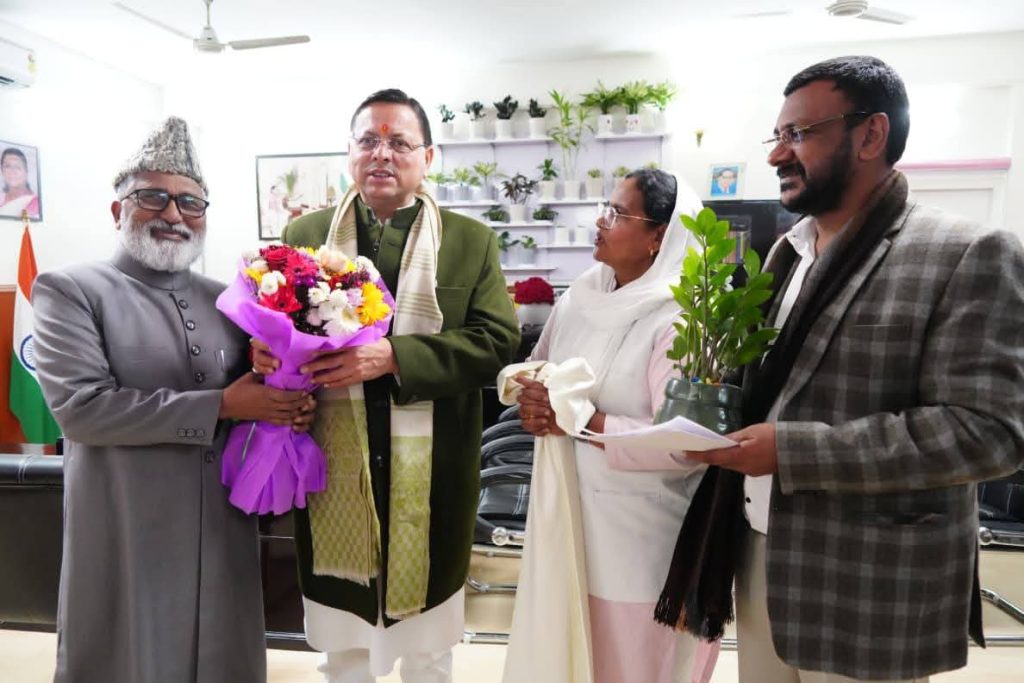
Outgoing Madrasa Board Chairman Shamoom Qasmi said that studying the national education curriculum would help minority children connect with global progress. At the same time, Waqf Board Chairman Shadab Shams has described the decision as historic and has also claimed that after the Uniform Civil Code (UCC) and the Triple Talaq law, this reform would transform religious madrasas into modern educational institutions and improve the standard of education among minority students. Minority Commission Vice-Chairperson Farzana Begum observed that the decision would enable minority children to acquire quality education, access better employment and business opportunities in India and abroad, and integrate more effectively with mainstream society, for which she expressed gratitude to the Dhami government.
CM Dhami has defended the decision by stating that until recently there was very little clarity on what was being taught in madrasas, on who was studying and teaching there, and how funding was being utilised. He claimed that despite government scholarships being provided, there was no proper accounting mechanism, and investigations revealed several irregularities. Referring to the closure of over 200 illegal madrasas, the CM has reiterated that no form of unchecked religious or sectarian education would be permitted in Devbhoomi Uttarakhand. He asserted that the minority students would now receive education based on the national curriculum, which will help shape their future and enable them to compete on equal footing. Dhami has further argued that earlier government benefits largely reached only the Muslim community under the minority category, whereas the new framework would ensure equal opportunities for all the minorities, including the Jains, the Sikhs, the Christians and the Parsis and the Buddhists, a step towards equity, integration and long-term educational reform.
Govt claims U’khand State Minority Education Authority will reform system