
By Radhika Nagrath
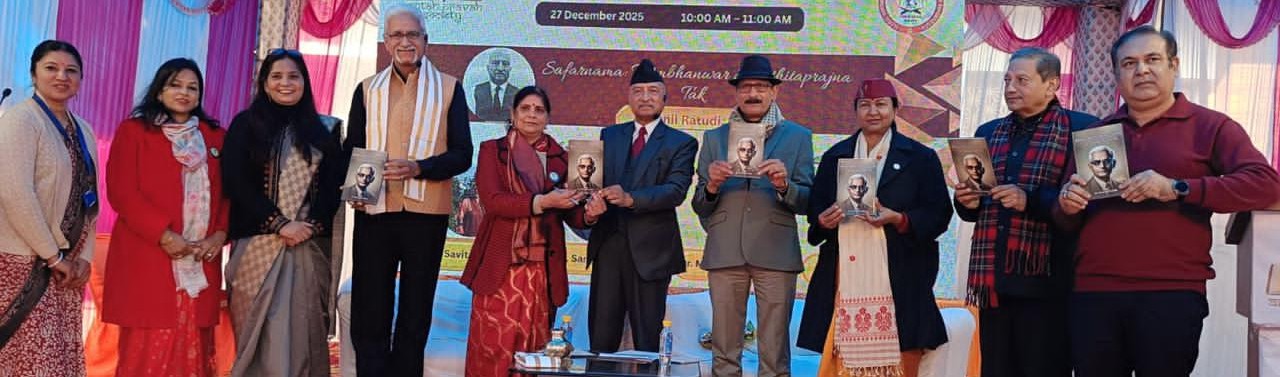
HARIDWAR, 27 Dec: The second day of the Haridwar Literature Festival began with a thoughtful and introspective session titled “From Prem Bhanwar to Sthitpragya.” The keynote speaker was former Director General of Police of Uttarakhand, Anil Raturi.
During the session, Raturi remarked that creativity is not easy to fully comprehend, but a person with a trained and sensitive literary perspective can better understand its deeper layers. Describing love as the highest ideal human capacity, he said that love has the power to transform an individual from within.
He also shared personal anecdotes from his years in the police service. In his address, he emphasised that the final evaluation of any literary work rests not with the author but with the reader, as a creation attains completeness only through the reader’s experience and sensibility. The session was moderated by Sanjay Handa, and Uttarakhand’s Chief Information Commissioner Radha Raturi was also present.
The session was jointly anchored by doctors Manjusha Kaushik and Reena Verma.
An important dialogue session titled “India’s Boundaries: Making & Remaking” was held. The keynote speaker was noted historian and former Director of the Lal Bahadur Shastri National Academy of Administration, Sanjeev Chopra. The session was moderated by Sushil Upadhyay and Sachin Chauhan.
In his address, Chopra elaborated on the historical process behind the making and remaking of India’s map. He explained how the geographical boundaries of states have changed over time and highlighted language as a key factor in the reorganisation of states.
Describing the forthcoming census as particularly significant, he observed that it could give rise to fresh demands for state reorganisation. He also drew attention to several important areas of debate likely to emerge from census data, including the urban–rural divide, comparisons between southern and northern India, and socio-economic questions such as the creamy layer versus non-creamy layer classification.
The session was jointly anchored by doctors Deepa and Mukesh Gupta.
A special dialogue session focusing on Hindi songs was organised at the Haridwar Literature Festival. District Development Officer Lalit Narayan Mishra shared his thoughts on the tradition of Hindi songs and their historical evolution.
Mishra noted that songs are an integral part of Indian folk life and have served as carriers of culture in the oral tradition for centuries. He added that songs are among the most powerful mediums of emotional expression, with their themes deeply rooted in everyday life. The session was moderated by young writer Dr Shiva Agrawal.
During the interaction, Mishra also recited his self-composed songs, which were warmly appreciated by the audience. The session was jointly anchored by doctors Pallavi Rana and Saloni.
About The Author