By Bijoya Sawian
Dehradun, 6 Feb: The Jaipur Literary Festival was grand and glamorous in a singularly different way. The glitter lay on the written and spoken word of the writers, thinkers, artists, critics, scholars, publishers and readers from across the globe. Its importance was defined by the sheer depth and power of speakers like Nobel Laureate Abdulrazak Gurnah, Booker Prize winners Daman Galgut and Bano Mushtaq, authors of repute Kiran Desai, Esther Dufflo, Sudha Murthy, Vir Das, Avi Shlaim, Ian Hislop, Gaur Gopal Das, Amish, Malashri Lal, Dr Karan Singh, Swapna Liddle, Vrinda Grover, Namita Gokhale, William Dalrymple and one of the best writers in this august gathering was our very own, Stephen Alter.
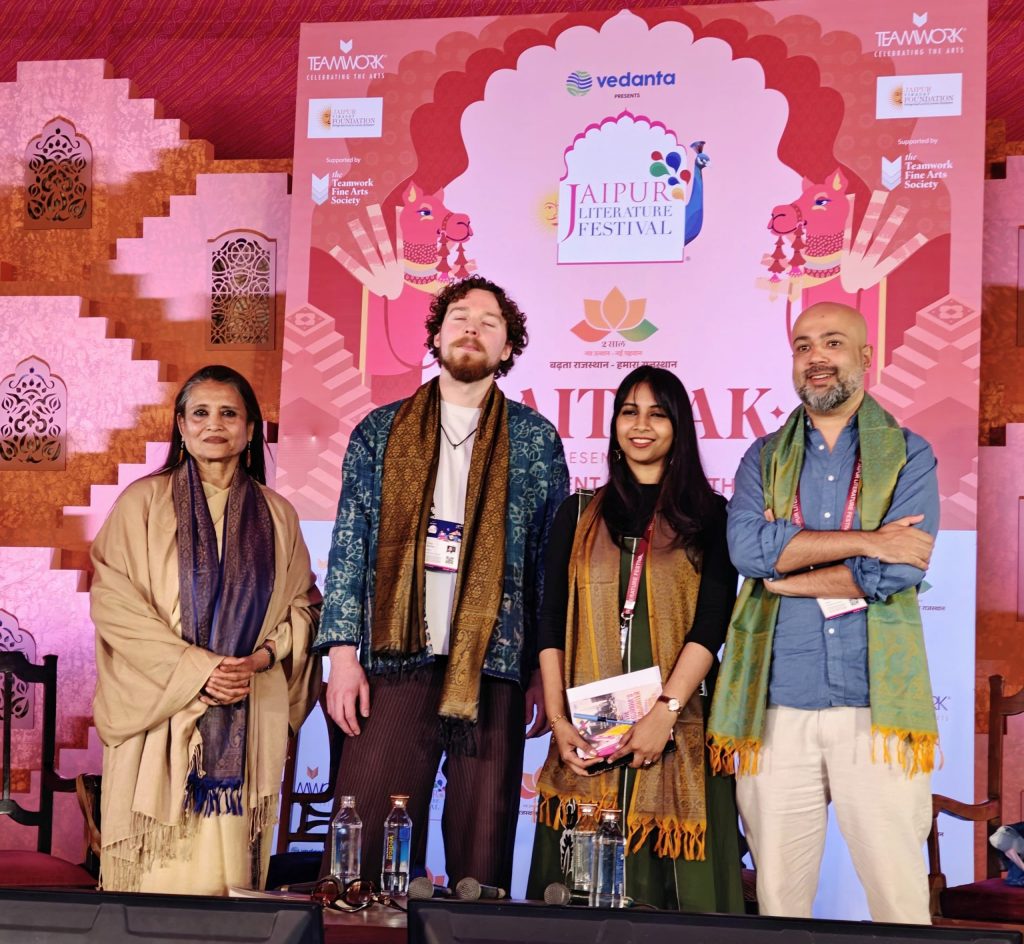
At this particular festival I was representing my home state, Meghalaya. There were four of us from the North East, Hoihnu Hauzel from Manipur, Prajwal Parajuly from Sikkim, Rashmi Nazary from Assam and me. The first published writer from Bhutan, Ashi Kunzang Choden, was a great asset to all our sessions. A young and upcoming author, Bhavika Govil, proved to be an excellent moderator, one who took her assignment with pride and commitment. This is important because the sessions were highly appreciated and people commented that they were enlightened and charmed by a little- known part of India.
On the whole it was, undoubtedly, a highly stimulating experience and I savoured the session of Joseph Koener and Stephen Greenblatt conversing about Art In a State of Siege, The Measure of Justice with Vrinda Grover, Ketu Shah and Ashwani Kumar. There were emotional discussions on the Gaza Genocide and heated sessions on Why Iran Is Burning. Exceptional, disturbing and yet humorous was the session Autocracy, INC-Dictators Who Want to Rule the World which featured Anne Applebaum conversing with Edward Luce. The lighter yet interesting ones with Anirban Bhattacharyya, a regular at the Doon Literature Festival, whose books on real life crimes sold out by the third day, the poetry sessions and Rijuta Diwaker’s, The Wisdom of Indian Food were delightful. Sanjoy Roy’s book launch was a big miss but I had the pleasure of meeting his charming wife Puneeta Roy.
Worth mentioning are the women centric sessions on male domination, the plight of prostitutes, the othering of sexual orientation and the women, very often, being the women’s worst enemy. I was fortunate to have been present in a powerful session in which the famous lawyer, human activist and women’s right activist, Vrinda Grover, and Swati Pande, the author of Invisible in Plain Sight-Voices From The Bylanes of Kamathipura, articulated their concerns and the way forward. My Sister and Other Lovers by Esther Freud, the great-grand daughter of Sigmund Freud, Wild Swan’s by Jung Chang and Ghosted by Eric Chopra about the Delhi Djinns were riveting sessions which take you ‘somewhere else’. This was a much needed reprieve after heavy sessions that weigh on you after they are over.
The unique feature of the Jaipur Literature Festival was the ability to choose where you want to be, literally and mentally! Just a few minutes’ walk, towards your chosen direction, in the spacious grounds of the Amer Clarks, one entered the halls and enormous tents that were imaginatively adorned as if to suit the themes and topics of discussion. It is an aspect we can think about here in Dehradun. Notable and impressive were the volunteers at every corner of this enormous venue which, of course, we have perfected here in our town especially in The Valley of Words Arts and Literature Festival.
The book launches of Dr Karan Singh, the talks by Javed Akhtar and Feroza Gujral on Satish Gujral were held in the Durbar Hall. Most of the philosophical sessions were in the Surya Mahal where we had ours. It began with an amazing session on Nicholas Roerich, the Russian painter who lived in Manali, in a gripping conversation between Stephen Alter and Vladamir Zeitsev about Roerich’s deep connection with the mountains around him, so startlingly visible in his paintings. It was followed by a session on The Relevance of Sri Aurobindo with the author of the book, Prashant Singh. Children’s Books sessions and those on art, music and poetry were in the Bagaan, a charming nook surrounded by trees and shrubs. Charmi Chedde from Bhutan had marvellous story telling sessions there done in her inimitable style combining different creative mediums. Children’s books were given due importance. Northern Lights -Children’s Literature from Norway had Oliver Moystad in conversation with Truda Spruyt. Books by Indian authors should be encouraged much more before children read books from other countries. It is a challenge to write for children and the topics of interest differ from region to region and it also depends which economic background you are writing for. During my visit and talk to the children of classes 6,7,8, of the elitist Maharani Gayatri Devi School as part of the JLF Outreach Programme, I was enlightened and learned more than I taught. The titles that the children had chosen were- What If, Conversation with a Robot, Some People Are Made of Clay, Meeting Myself. This was the last leg of the journey at JLF.
At the venue the closing ceremony was a terrific debate on the topic, Freedom of Speech is a Dangerous Idea. It was more like a match of two brilliant teams with a singular goal. Pavan Varma summed it up cleverly well, “Freedom of speech is a must but it must be made not dangerous.”
Ever grateful I am for the Authors’ Lounge, an oasis of peace and calm, super coffee and tea and gourmet food. Sitting there I often ruminated that I wish JLF did not attract so many young people who hung around the Front Lawn talking in loud voices while gorging on momos and other snacks. The clothes, trinkets and souvenirs were, thankfully, tucked away in a separate part of the venue.
I missed so many sessions because they clashed but that always happens in litfests. I had to miss two grand dinners out of sheer fatigue! I managed three which was, to me, a great feat. The famous publisher, Mita Kapur’s ‘ghar ka khana’ dinner needs a mention for the excellent meal, well-chosen guest list and the volume of the music which floated all over her beautiful garden.
After the mind-boggling five days’ treat I drove back to Delhi and as we sped on that super highway to our capital city, the most polluted city in the world, I tried to think of what I kept back and what I sifted out. What was really of importance and relevance in the final analysis? All I could think of was the words of Sri Aurobindo, who more than a hundred years ago had posed a question that still defines our future. In the words of the US based highly successful doctor, scholar and author, Pariksith Singh, Sri Aurobindo‘s concern was “Will we evolve beyond our current limits -or be overtaken by the dehumanising forces of the State and the Machine?” His integration of modern thought and ancient wisdom pointed out to a new kind of civilisation that can only emerge through a radical shift in human consciousness.
That shift can only come if it begins from within each one of us. We are living in a difficult world and confusing and disturbing not only for children but adults as well. In smaller places like Dehradun, we could stand out by having litfests which are not only cerebral and entertaining but also useful and rewarding for all, revolving round pertinent issues.
Dehradun is, to me, almost unrecognisable. Everything we do should be geared towards bringing its glory back. Let us celebrate the joy of reading and meeting like-minded people in an atmosphere filled with the stimulation of the intellect not the ego, let the grace and kindness return if not the greenery and fresh air. We can do it if we try because it is in the intangibles that changes begin.
JLF – A Literary Extravaganza