
By Arun Pratap Singh
my uttarakhand news Bureau
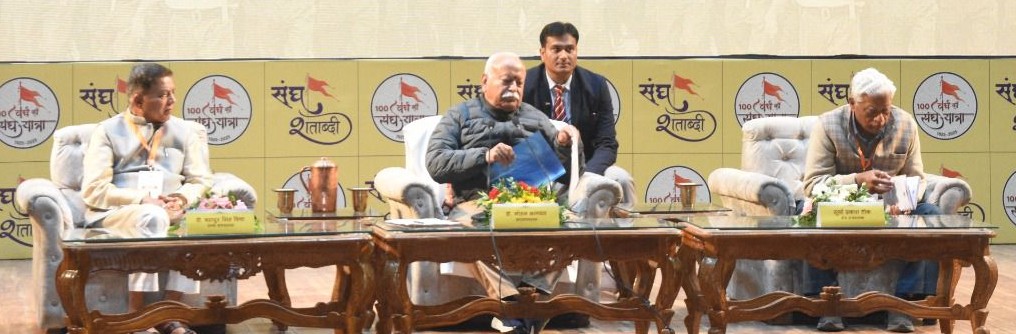
Dehradun, 22 Feb: On the occasion of the completion of 100 years of the Rashtriya Swayamsevak Sangh, a prominent public symposium and an inter-sectoral dialogue on the theme “Sangh Yatra – New Horizons, New Dimensions” was organised at the auditorium of the Himalayan Cultural Centre here today. The programme was addressed by RSS Sarsanghchalak Mohan Bhagwat.
The event began with the Sarsanghchalak offering floral tributes before the portrait of Bharat Mata, followed by a collective rendition of Vande Mataram. The proceedings were conducted by Vibhag Prachar Pramukh Gajendra Khanduri.
Prant Karyawah Dinesh Semwal, in his introductory remarks, informed the gathering about various programmes organised in Uttarakhand under the Sangh’s centenary year, including path sanchalan on Vijayadashami, ghosh sanchalan, an extensive door-to-door outreach campaign, direct contact with families and Hindu conferences. He also elaborated upon the forthcoming plans under the centenary celebrations.
Addressing the gathering on this occasion, Mohan Bhagwat observed that the Sangh cannot be understood merely by looking at it from outside. He said that some people consider it a semi-military organisation after witnessing path sanchalan, others assume it to be a musical group upon hearing patriotic songs, and yet others view it solely as a service organisation after observing its welfare activities. However, he asserted that the Sangh is a broad social force beyond such narrow definitions. Drawing an analogy, he remarked that just as the sweetness of sugar can be known only by tasting it, the Sangh can be understood only by associating with and participating in its work.
He clarified that the Sangh does not compete with any organisation. If the nation becomes strong, its citizens will also become strong; if the nation is weak, individuals will not feel secure even in their own country. The objective of the Sangh, he said, is individual character-building, as a strong individual alone can create a strong society and nation.
Referring to the life of RSS founder Dr Keshav Baliram Hedgewar, Bhagwat said he was a born patriot and a man of exceptional talent. As a child, Hedgewar had refused to accept sweets distributed in school on the birthday of Queen Victoria, stating that he would not participate in celebrations of a ruler who governed his country. He was an active member of the Anushilan Samiti and even faced sedition charges by the British for singing Vande Mataram. His resolve was that India should not become subjugated again, and it was with this objective that the Sangh was founded.
Bhagwat stated that after a long civilisational journey of nearly 2,000 years, the world now looks towards India with renewed hope for leadership. He called upon the audience to associate themselves with Sangh activities and contribute towards strengthening society and the nation. He also urged the gathering to take a pledge to lead India to the pinnacle of glory through the Sangh’s principles of “Panch Parivartan”.
Bhagwat emphasised that the Rashtriya Swayamsevak Sangh does not seek political power but aims to organise Hindu society, promote cultural unity and foster character-building. He also highlighted the need for social harmony, vigilance against threats and the strengthening of national identity. Asserting that the RSS has no political ambition and does not function as a political entity. He clarified that the Sangh does not compete with any group and is wholly committed to uniting Hindu society, urging people to strengthen their resolve for Akhand Bharat rather than fear division. Stressing the removal of internal divisions within Hindu society, he underscored the importance of social harmony and defined “Hindu” as a cultural identity encompassing everyone living in India, stating that Bharat’s culture is inherently inclusive. Bhagwat observed that the reality of the RSS cannot be understood merely from the outside, describing it as a broad social force beyond narrow perceptions. He reiterated that the Sangh is not in competition with any organisation and stated that if the nation is strong its citizens will also be strong, whereas a weak nation renders individuals insecure. The objective of the Sangh, he said, is individual development, as only strong individuals can build a strong society and nation.
During the interaction session, responding to a question on discrimination and social change, he stated that the root cause of social evils and discrimination lies not in the system but in the human mind, and that discrimination can be eradicated only through a change in behaviour. On technology and culture, he said that technology is a means and not an end, and must be used with restraint and discipline, emphasising the need to devote time and intimacy to family life without sacrificing human values. On cultural identity and power, he stated that those who work to unite are Hindus and that devotion to the motherland is essential, adding that while the world often values power more than truth, strength must be acquired but exercised with restraint. Responding to a question on the role of women, Bhagwat said women are completely independent and their participation in national governance should not be confined to 33 per cent but may extend to 50 per cent, noting their important role during the lockdown period. On issues such as reservation, classification and the Uniform Civil Code, he said society must function with authenticity and harmony and rise above divisive thinking. He reiterated that the Sangh does not practise Hindutva politics but works for social upliftment through individual development, observing that corruption begins in the mind and must be eradicated there. He also emphasised the need to view population both as a burden and as a resource and called for a thoughtful policy to be implemented uniformly.
On the digital age, he said that technology is a means, not an end, and must be used with restraint and discipline. Families must nurture emotional bonds and devote time to one another, as human values cannot be sacrificed at the altar of technology.
On cultural identity, he said that one who works to unite is a Hindu, and devotion to the motherland is essential. The world, he observed, understands power more than mere truth, and hence strength must be acquired, though its use must always remain within moral limits.
Speaking on the role of women, Bhagwat asserted that women are fully independent and that their participation in national governance should not be limited to 33 per cent but may extend to 50 per cent.
He also asserted that the Sangh does not engage in the politics of Hindutva but works for social upliftment through individual character-building. Corruption, he said, begins in the mind and must also be eradicated there. Regarding population, he stated that it must be viewed both as a burden and as a resource, and emphasised the need for a well-considered policy applied uniformly.
The programme was attended by intellectuals from various fields, social workers, educationists, representatives from the industrial sector and a large number of swayamsevaks. The event concluded with the National Anthem.
About The Author