 First batch of Tata run skill centre in Kumaon University
my uttarakhand news Bureau
Dehradun, 2 Mar: SETU Aayog, State Institute for Empowering and Transforming Uttarakhand, the apex policy think tank of the Uttarakhand Government, has intensified its focus on agriculture and rural governance through a series of innovative initiatives undertaken over the past few days. The institution is now laying stress on addressing long-standing challenges confronting the hill agriculture while introducing technology-enabled rural service centres as evidence-based models for future policy formulation. It may also be noted here that Vice Chairman of SETU Aayog, Raj Shekhar Joshi, had recently presented some of its key strategies to Governor Lt Gen Gurmit Singh (Retd), who had appreciated the institution’s evidence-based and collaborative approach towards rural transformation.
 Light weight battery run power tiller for hills (a pilot project with Gates Foundation)
In collaboration with the Panchayati Raj Department, SETU Aayog facilitated the establishment of two pioneering Integrated Smart Village Centres with computers, trained staff and other essential equipment at Naudha village in Kotabagh, Nainital, on 24 February, and at Kanwad village in Devidhura, Champawat, on 25 February. These centres would function as grassroots governance and service-delivery hubs.
Speaking to my uttarakhand news, Vice Chairman of SETU, Raj Shekhar Joshi shared that additional centres are planned at Tilwadi in Dehradun and Nakote in Tehri Garhwal in the near future. He added that a total of 16 Integrated Smart Village Centres proposed during 2026. The Naudha centre was set up by REACH Foundation with support from Nokia under the Smartpur programme, while the Kanwad centre was established with support from Rallis India of the Tata Group and Aarti Foundation, IIT Roorkee. A large number of villagers, Gram Pradhans, Block Pramukhs and district officers attended the inauguration programmes.
The centres aim to expand digital access to public services, enable convergence of government schemes, promote skill development and support local livelihoods. They are intended to bridge the rural digital divide and strengthen last-mile governance. SETU Aayog has also allied with the Quality Council of India for the Sarpanch Samwad initiative to enhance grassroots dialogue and capacity building.
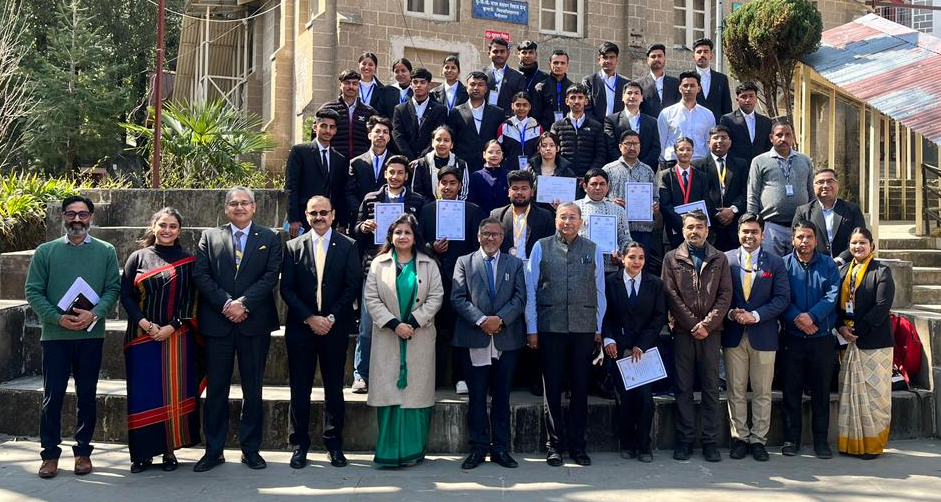
In addition, on 26 February, SETU Aayog organised a convocation of the first batch of trainees at the Tata Group-run skill centre at Kumaon University, Nainital. It may be noted that a memorandum of understanding (MoU) was signed in June 2025 among SETU Aayog, the Skill Development and Higher Education Departments, Kumaon University, Tata STRIVE and the Taj Group. The centre launched its operations in October 2025. The first batch comprising 24 students have successfully completed the course and 100 per cent placements were offered in February 2026, of which 80 per cent have already been accepted. A new batch of the course training has also been launched. Vice Chairman Raj Shekhar Joshi described the initiative as a unique model launched amid several challenges, asserting that industry-led skill development programmes represent the future of employability enhancement in the state.
Besides this, SETU Aayog is simultaneously implementing an Agriculture Rejuvenation Programme in partnership with the Department of Agriculture, Social Alpha and the Gates Foundation. During a recent field visit to Khuteli in district Champawat, over 100 farmers, including women cultivators, shared encouraging feedback regarding pilot projects to address the menace of wild animals, pest infestation, low mechanisation and post-harvest losses. Similar pilot interventions are also being carried out in Agrakhal in Tehri.
The SETU Aayog team, accompanied by Joshi, also visited Barkandey and Khuteli villages, where feedback was gathered from farmers whose crops were treated with Herbolive+. The team inspected the fields, and farmers reported positive results, citing reduced crop damage and improved yields.
According to Joshi, preliminary findings indicate reduced crop damage through bio-secure spray trials, and plans are under consideration for establishing a Cold Storage–cum–Dryer Unit. A Standard Operating Procedure (SOP) to assess and mitigate the impact of wild animals on agriculture is being developed for future scaling.
Joshi stressed that SETU’s model of testing locally, validating rigorously, refining collaboratively and scaling institutionally holds the potential to create a replicable agriculture and skill development framework for the state. He also shared that reports on dairy transformation, waste management, hill irrigation models and support to the forthcoming Artificial Intelligence policy have almost been finalised, while work is also underway on a bio-energy policy among several other initiatives. The SETU Aayog had earlier also assisted in drafting the Electric Vehicle policy submitted to the Industries Department a few months ago.
Joshi along with his colleagues works closely with grassroots communities, Gram Pradhans, farmers, state departments and the corporate sector. He stated that innovation, collaboration and an implementation-oriented approach remain central to all SETU initiatives. Despite numerous challenges, the institution continues to function with commitment and collective effort as its guiding principles.
About The Author