
my uttarakhand news Bureau
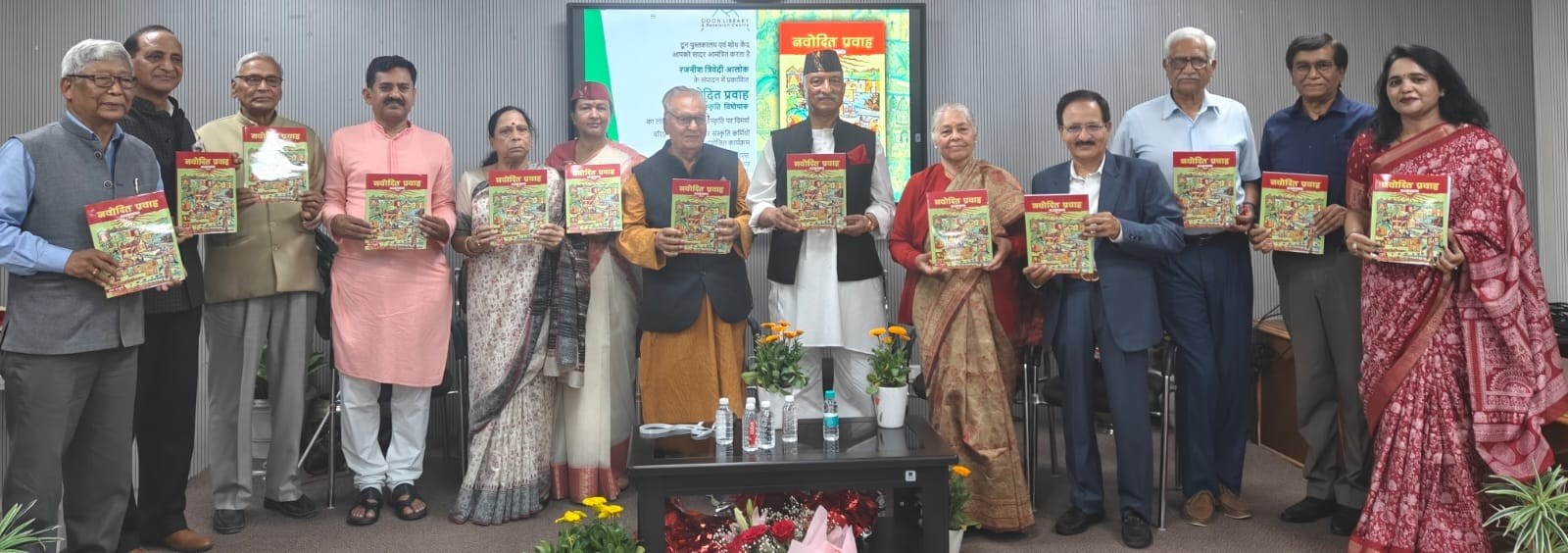
DEHRADUN, 11 Mar: The folk culture special issue of the literary journal Navodit Pravah, edited by Rajnish Trivedi, was released with fanfare by literary figures at a function held recently at the Doon Library and Research Centre, Dehradun. The function was followed by a discussion on folk culture. The chief guest of the function was Padma Shri Liladhar Jaguri, a senior poet and literary figure, while the function was presided over by Radha Raturi, Chief Information Commissioner of the State. Following the release, a discussion on folk culture was held, in which senior writer Anil Ratudi, Padma Shri Madhuri Barthwal, lyricist Ramvinay Singh, and Kriparam Nautiyal participated. Vice-Chancellor of Uttarakhand Sanskrit University Ramakant Pandey, was also present.
In his address, Chief Guest Liladhar Jaguri said that the released special issue is extremely scholarly and collectible. He mentioned the poems published in the special issue and said that in today’s time, poets who can express their emotions in a new way using words in their language are rare. He said that the memory of Prākṛt poems comes to mind as one looks at this issue, and it becomes clear how many intellectual homes poetry has changed. The presentation of folk culture from Kashmir to Kanyakumari and from Gujarat to Northeast Assam, Arunachal, and Nagaland has been presented with great interest. The descriptions of the Kumaoni, Garhwali, and Jaunsari lifestyles of Uttarakhand have been presented. The famous Kumaoni Jhoda has been presented in Sanskrit translation. Mr. Liladhar Jaguri said that nowadays, the publication of such a scholarly journal is not just a coincidence but a remarkable event, and he considers it a great honor to have Dr. Girija Shankar Trivedi’s poem “Someone is Coming Home” in this issue. He said that the special issue on folk culture presents the critique of Indian folk culture through the trends and creators of literature in almost all languages of India, starting from Pali literature. He described Dr. Sudha Pandey’s article on Pali literature as very important, which reminds us of the dialogues between Bhikshu Naga Sen and Milind in addition to spirituality in the Buddhist literature, Tripitaka, and Ther Gathas.
The chief speaker of the function, former DGP and literary figure Anil Ratudi, presented a thorough analysis of the folk culture special issue and said that the literary journal “Navodit Pravah”, 2026, annual issue, contains about 107 literary articles related to folk culture. In his editorial, the editor has highlighted the importance of folk culture, its literature, music, painting, and craft, which always serve as the foundation for the development of high civilization. This issue encompasses the infinite colorful folk culture of a vast country like India. While it contains articles on the remote tribal culture of Arunachal, Mizoram, etc., it also includes interesting articles showcasing the folk culture of almost all major states of India. The editor has given space to regional folk cultures such as Awadh, Bhojpuri, Kannauj, Maithili, Vidarbha, Malwa, Garhwal, Kumaon, Jaunsar, and Rawai in this section. Given the infinite cultural diversity of India, it is said that to express the infinite diversity displayed by India in the world’s diversity, something more needs to be added… Reading it will be an enriching experience for any reader! I congratulate the editorial team for publishing this excellent edition with great effort.
Renowned poet and journalist Somwari Lal Uniyal Pradeep expressed his views, saying that language, literature, culture, art, and music originate from the emotional foundation of the people. Inspired by the people, human consciousness moves forward in various fields of life according to its talent. In fact, we cannot even imagine life without the people. The democracy we have accepted today cannot be meaningful without the people.
On this occasion, speaking about folk culture, Sanskrit scholar and poet. Ram Vinay Singh said that the ‘Vedas’ are the standard form of scholarly and pandit-like knowledge accumulated from the knowledge of human beings, and ‘Loka’ is the accepted world of the common people, different from this. This is why the Vedas are accepted in some places, while the people are primarily accepted in others; however, human society has accepted it as a separate tradition. The customs, traditions, food, family relationships, clothing, jewelry, and means of adornment, arts, festivals, vows, medicinal knowledge, economic activities, and religious life of the people all combine to form the folk and folk culture. Undoubtedly, all these elements always exist with human nature and consciousness. Prof. Singh effectively expressed the journey of folk language and dialects from the folk perspective of Sanskrit to the modern folk language and dialects.
At the beginning of her speech, former Vice-Chancellor and scholar Sudha Pandey said that the folk culture special issue of “Navodit Pravah” is a messenger of the living message of folk culture, introducing readers to the wonderful wealth of the people, in which the literature of the journey of the people from north to south is not just literature, but the colorful life of the people is revived. The special issue, enriched with folk languages, depicts the cultural heritage of India and various aspects of folk life. The form of the people becomes the manifest form of the soul of all human beings, when songs, dance, and life become the means of expressing the wonderful form of the people, and not just the people, but the consciousness of all human beings is immersed in the ocean of joy. The flow of the people, invoked from the Vedic mantras of the oral tradition, has been the source of joy and bliss for all living beings for a long time. In the company of the people, not just humans, but all animate and inanimate nature rejoices. Culture is the thread that binds the people, and literature or scripture is the bright form of that fine thread. This form of the people is a witness to the unconscious tendency in the human mind, which becomes a witness to every age in the form of myths, and this mythical power is hidden in the life of every region in the form of collective mind beliefs, and the poet and artist’s consciousness word it, and with rhythm and melody, it transmits energy and joy to the minds of readers and viewers. When one reaches this emotional foundation, all the audience experiences the same transcendental joy, and this experience becomes the mother of scripture. The special issue of “Navodit Pravah” has been released for readers with important elements of Indian languages and folk life, with the cooperation of learned writers, and she congratulated the editorial team.
Madhuri Barthwal emphasized the importance of folk music in folk culture and said that music is what is sung together, and a true folk song is one that comes from the soul. We should connect with our people and our land.
Radha Raturi, in her presidential address, highlighted various aspects of folk culture and folk life. She said that this compilation of Navodit Pravah is focused on folk culture. This issue is fully capable of deeply displaying the soul of the diverse regional societies of India, in addition to Uttarakhand. Trivedi has very skillfully presented and preserved the cultural diversity of different regions of India in this issue.
At the beginning of the function, Rajneesh Trivedi ‘Alok’, editor of Navodit Pravah, gave a welcome address. The function was skillfully conducted by poetess Bharti Mishra, and before the conclusion of the function, a vote of thanks was given by the program officer of the center, Chandrashekhar Tewari.
On this occasion, former Chief Secretary of Uttarakhand, Nrip Singh Napalchyal, Dr Pankaj Nethani, Dr Data Ram Purohit, Tapas Chakraborty, Jayaprakash Khankariyal, Satyanand Badoni, Manju Kala, Someshwar Pandey, Hari Chand Nimesh, Sachin Chauhan, Shraddha Mishra, Dr Kshama Kaushik, Kavita Bisht, Dr Lalima Verma, Dr RP Bhardwaj, Bhagwan Prasad Ghildiyal, Dr Sudesh Byala, Dr Baijnath, Madhulika Srivastava, Sunil Trivedi, Dard Garhwali, Jayprakash Pandey, Dr Prakash Pant, Shobha Parashar, Kulbeer Channi, Sudha Jugran, Anuradha Jugran, Neeta Kukreti, Bharati Anand, DN Dobhal, librarian Dr DK Pandey, Sundar Singh Bisht, Jagdish Singh Mahar, Dr Lalita Prasad, Rakesh Kumar, and a large number of distinguished people, readers, and writers were present.
About The Author