
CM leads recital of Vande Mataram in Doon on Republic Day
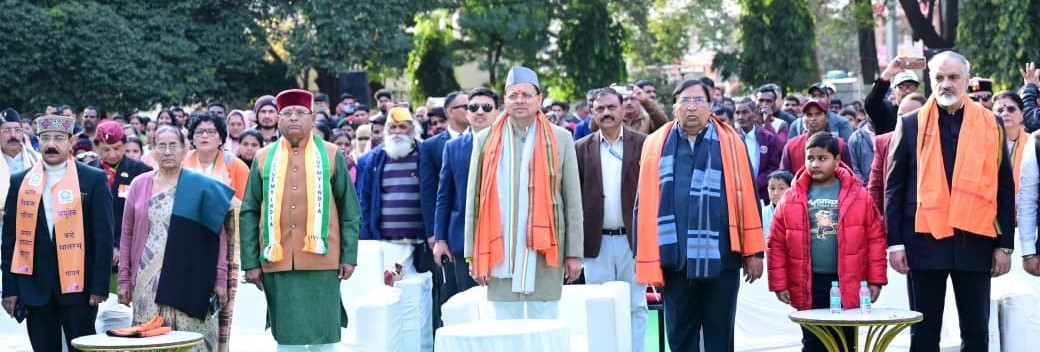
my uttarakhand news BureauDehradun, 27 Jan: Chief Minister Pushkar Singh Dhami participated in a mass recital of Vande Mataram organised by Bharat Vikas Parishad at Gandhi Park here yesterday on the occasion of Republic Day. Extending warm greetings to the people on this occasion, the CM said it is a matter of immense pride and joy to be part of such a dignified collective recital, especially as the national song marks 150 years since its composition.
Dhami also spoke on the enduring legacy of Vande Mataram, written by Bankim Chandra Chattopadhyay, which had become a rallying cry during the freedom struggle and provided generations with a shared cultural and patriotic identity. He recalled how Rabindranath Tagore’s musical rendering elevated it from a slogan to a living symbol of unity, sacrifice and devotion to the nation. He emphasised that Vande Mataram is not merely a poem but an expression of faith and duty towards Mother India. When sung by thousands together, it unites hearts, thoughts and resolutions. The CM commended Bharat Vikas Parishad for bringing this sentiment to the masses through the event.
On the historical significance of Republic Day, the CM said the day is etched in golden letters as India implemented its Constitution in 1950 and began its journey as a democratic republic. He paid tribute to the members of the Constituent Assembly, the freedom fighters, the revolutionaries, Satyagrahis and the brave personnel of the army and the police who sacrificed their lives for the unity and integrity of the nation. He asserted that the Constitution is not merely a legal document but a reflection of India’s ancient civilisation, democratic values, its cultural consciousness and noted that despite doubts about sustaining democracy in such diversity, India today stands as the world’s largest democracy.
Highlighting national progress, he said that, under the leadership of Prime Minister Narendra Modi, India is moving rapidly towards the goal of becoming a Developed India and has emerged as the world’s fourth-largest economy. He added that border security is being reinforced through modernisation of the armed forces, while India asserts its cultural heritage with confidence on the global stage.
Regarding governance in the state, Dhami claimed that Uttarakhand is working tirelessly for all-round development under the PM’s guidance. He stressed that the government has gone beyond announcements to implement concrete decisions. Strict anti-conversion and anti-riot laws have been enforced to maintain social peace, Operation Kalnemi has targeted those defaming Sanatan Dharma, and the Madrasa Board has been abolished. He highlighted measures against illegal encroachments and mafia activities through stringent land laws.
He noted that Uttarakhand has become the first state to implement the UCC. To safeguard the future of youth, a strong anti-copying law has been enacted, leading to the imprisonment of over 100 members of the copying mafia. He shared that in the last four and a half years, 27,000 youths have secured government jobs. He informed that since the state’s formation, its economy has grown 26 times and per capita income has risen 17 times, with development further accelerated by increased power generation and the doubling of the road network.
Citing a recent report of the Migration Prevention Commission, the CM claimed that 44 per cent reverse migration has been recorded, showing that people are returning to their villages with hopes of employment and a better future. He added that Uttarakhand ranked first in the country in the Sustainable Development Goals Index 2023-24 released by NITI Aayog. Concluding his address, he affirmed that the government is working with a ‘resolution without alternative’ to make Uttarakhand the best state in the country, expressing confidence that citizens will strengthen both the state and the nation by fulfilling their duties.
Among those present on the occasion were Rajya Sabha MP Naresh Bansal, MLA Khajan Das, MLA Savita Kapoor, other public representatives and a large number of local residents.
About The Author