
By Arun Pratap SinghGarhwal Post Bureau
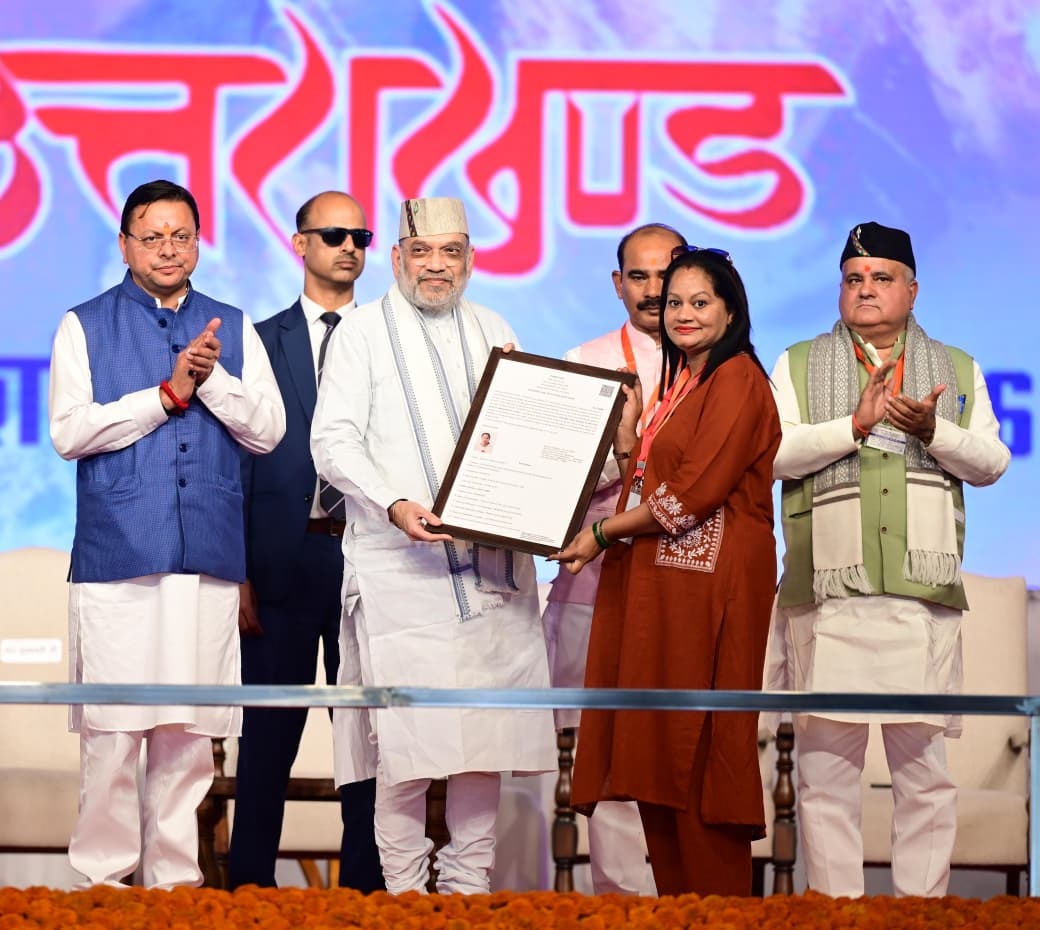
Haridwar, 7 Mar: Union Home and Cooperation Minister Amit Shah arrived in Haridwar today and participated in a major public programme where he handed over appointment letters to 2,000 police constables. In all, five constables were formally handed over their appointment letters on the stage on this occasion. However, more significantly, Shah also presented citizenship certificates to five Hindu families who had come from Pakistan and Afghanistan before 2014 after facing religious persecution, under the provisions of the Citizenship Amendment Act (CAA). In all, 153 refugees from Pakistan and Afghanistan living in Uttarakhand have been granted Indian Citizenship. Of them, 147 persons hail from Pakistan and 6 from Afghanistan.
On the occasion, Shah also inaugurated and laid the foundation stones of several development projects with a total cost exceeding Rs 1,100 crore. He began his address with the slogan ‘Bharat Mata Ki Jai’ and said that the voice of the people of Uttarakhand must reach Delhi.
Among those granted citizenship was Jaspal Kumar, who had arrived from Pakistan after fleeing the brutal killings of Hindus there. Disturbed by the atrocities against the community, he sought refuge in India. Shailesh, who also came from Pakistan, had similarly taken shelter in India after facing religious persecution. Shailesh had been serving as the priest of the Hinglaj Mata temple in Balochistan, Pakistan. Durganath Rajput, who came from Karachi in Pakistan, was also granted Indian citizenship. He had sought refuge in India after being distressed by the atrocities being committed against women members of his family.
Kuldeep Kumar, who belongs to the Sikh community, had been living in India after seeking refuge from the Swat region of Pakistan and had applied for Indian citizenship. He had been facing religious discrimination in Pakistan, which made it difficult for him to continue living there.
Hanseri Bai was also granted Indian citizenship by the Union Home Minister at the Haridwar programme. Hanseri Devi had come from Afghanistan. Since the change of regime in Afghanistan, it has become increasingly difficult for people of other religions to live there. In such circumstances, she had applied for Indian citizenship, which has now been approved, making her an Indian citizen.
Earlier in his address at the programme, Amit Shah launched a sharp attack on the Congress, alleging that the party had devoted all its energy to facilitating the entry of infiltrators. He said the Dhami government had removed around 10,000 encroachments in the state and asserted that the government would ensure that infiltrators were driven out not only from Uttarakhand but from Kedarnath Dham to Kanyakumari.
Addressing the gathering, Shah strongly slammed the Leader of the Opposition in Lok Sabha and senior Congress leader Rahul Gandhi for opposing CAA under which the refugees have been granted Indian citizenship. Shah said that Rahul Gandhi opposes every step and decision of the government because he sees negativity in everything. Referring to the tenure of previous Congress governments, Shah alleged that several charges had surfaced during that period, including the sting operation involving former Chief Minister Harish Rawat and the scholarship scam. He also alleged that a system of commissions had prevailed earlier.
Amit Shah on the occasion also launched the e-Zero FIR system in Uttarakhand.
The e-Zero FIR system, being introduced under Section 173 of the Bharatiya Nagarik Suraksha Sanhita, has been developed particularly to provide prompt assistance to victims of financial cyber fraud involving amounts exceeding Rs 1 lakh. Under the new system, complaints received through the 1930 helpline or the National Cyber Crime Reporting Portal will be registered as e-Zero FIRs at the State Cyber Police Station in Dehradun and will thereafter be immediately forwarded to the concerned police station through the Crime and Criminal Tracking Network and Systems (CCTNS).
This system will enable the police to take swift action during the crucial “golden hour”, initiate the collection of evidence and freeze suspicious transactions at the earliest stage. The move is expected to significantly enhance the chances of recovering the defrauded money.
About The Author