
By Shruti Kotiyal & Aabshar Abbasi
DEHRADUN, 28 Feb: Amidst the vibrant floral displays and lively cultural festivities of Vasantotsav 2026 at Lok Bhavan in Dehradun, a compelling narrative of women’s empowerment is quietly taking shape throughout the exhibition stalls. Organised annually at the picturesque Lok Bhavan (Raj Bhavan), this festival has transformed from a mere seasonal celebration into a crucial platform for diverse entrepreneurs. This year, a special emphasis is placed on women entrepreneurs hailing from various regions of Uttarakhand, providing them with an opportunity to showcase their innovative crafts, artisanal products, and unique services. The festival not only allows these talented women to expand their market reach but also aims to strengthen their economic independence and self-sufficiency.

This year, several stalls led by women highlighted how local enterprise, sustainability and innovation are reshaping the socio-economic landscape of the hill state. Students from the School of Media and Communication Studies, Doon University, have explored these inspiring stories of passion, resilience and creativity, highlighting the significant role women play in driving economic growth and social change in the region and have structured them here as a mark of redefining empowerment ahead of the world celebrating the upcoming International Women’s Day on 08 March 2026.

Among the most compelling stories is that of Nikita Rawat, whose journey from medical science to cultural entrepreneurship reflects the evolving face of women-led innovation in Uttarakhand. With an M.Sc. in Medical Microbiology and professional experience in research and development across medical and pharmaceutical sectors, Rawat’s career once revolved around laboratories and scientific research, including work on artificial cultivation of Cordyceps militaris and Tuberculosis studies.

However, the COVID-19 pandemic marked a turning point. Relocating to Chamba in Tehri Garhwal during the second wave, she began cultivating button mushrooms as a means of rebuilding confidence amid uncertainty. Eventually returning to her ancestral village in Chamoli district, she rediscovered the traditional art of ‘Bhojpatra’ craft and began creating handmade products rooted in Himalayan heritage.

Her initiative received recognition at the Foundation for Innovation and Entrepreneurship Development (FIED) at the Indian Institute of Management Kashipur, and she later showcased her work at the Uttarayani Kauthik Mahotsav 2026. Today, exhibiting at Vasantotsav at Raj Bhavan marks not just personal achievement but the symbolic recognition of grassroots women entrepreneurship at the state’s highest institutional platform.

Rawat’s vision extends beyond individual success. She aims to take Chamoli’s traditional art forms to national and global markets while inspiring women and youth to pursue self-reliance rooted in local identity.
In another section of the festival, the National Association for Parents’ and Students’ Rights, led by Afsana Sultana in Raipur, Dehradun, is drawing attention for its initiative “Charity Bazaar.” The organisation promotes sustainability by repurposing donated clothes into handmade garments, thereby reducing waste while generating employment for women.

Operating for nearly a year, the initiative also provides financial support to women for education and marriage needs. Participating in Vasantotsav for the first time, the group reported encouraging sales on the opening day, reinforcing the importance of such public platforms for emerging women-led ventures.
From Tehri Garhwal, Kusum Nautiyal’s venture “Hitaayu Nature” addresses the rising prevalence of junk food culture. Motivated by the desire to provide healthier food choices for her children, she began with traditional family recipes and developed a range of oil-free products. Just months into her entrepreneurial journey, Nautiyal considers Vasantotsav her first major exposure to a wider consumer base.
Earlier, a recommendation enabled her participation at the Saras Mela in Dehradun, but exhibiting at Raj Bhavan has further strengthened her confidence. For first-generation women entrepreneurs in Uttarakhand, such visibility can translate into long-term sustainability.
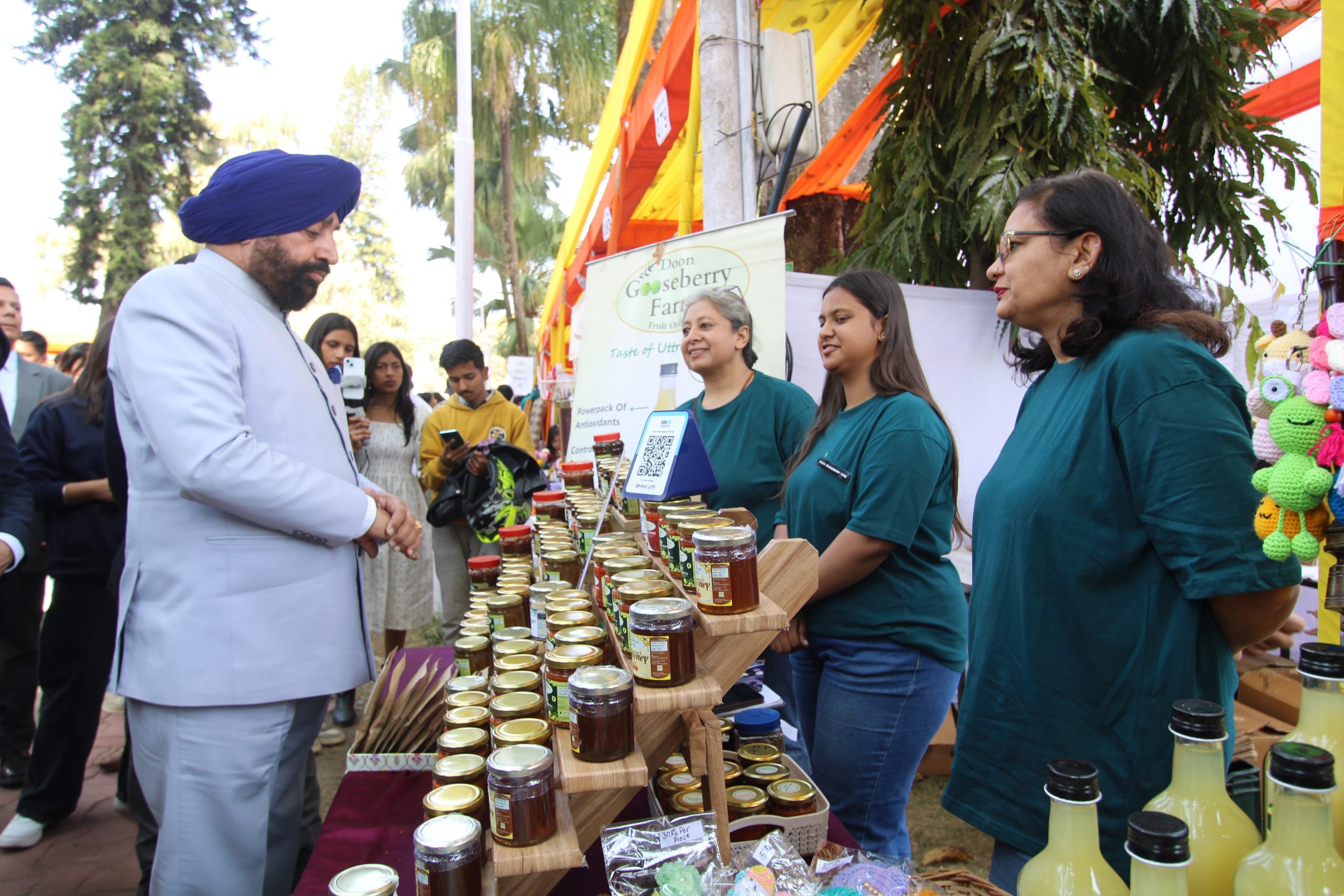
The Institute of Agriculture Training and Research, Dehradun, represented by Riya, Shagun and Tanushree, is using the platform to promote agricultural entrepreneurship among women. Through their Agri-Entrepreneur Club, they train women and students in honey production, oyster and button mushroom cultivation, and vegetable farming.
Importantly, their model covers the entire value chain, from production and processing to packaging, ensuring efficiency and reduced wastage. They said that participating in Vasantostsav has provided crucial exposure and networking opportunities that help grassroots initiatives scale beyond local markets.
Huma Ahmed of Jaipur Bangles, associated with Aasra Foundation, has been participating in Vasantotsav for the past seven to eight years. Her handmade jewellery enterprise employs around 40 to 45 women and young girls, many of whom face social restrictions or limited family support. For them, home-based production linked to exhibition platforms like Vasantotsav offers both income and dignity.
Similarly, Sapna Thapa, a student of media studies at Doon University, Dehradun and Sushma Thapa, representing “Sushma’s Creation” under Aagas Federation, specialise in crochet products and have been showcasing their work at the festival for six years. With institutional support from NGOs, they have managed to expand their scale of operations, reflecting how sustained exposure can strengthen small women-led enterprises.
In Uttarakhand, where migration, limited employment opportunities and geographical challenges often restrict economic growth, women-led self-help groups and micro-enterprises are increasingly becoming pillars of local development. Vasantotsav, by providing direct market access, visibility and validation at a prestigious venue like Raj Bhavan, functions as more than a fair; it serves as an enabling ecosystem.
For many of these women, participation is not only about sales figures but about confidence, networking and recognition. The festival bridges the gap between grassroots producers and urban consumers, reinforcing the idea that empowerment is not merely a slogan but a lived experience shaped by opportunity.
As Vasantotsav 2026 continues, the stalls run by women serve as living testimonies to how cultural platforms can transform local talent into a sustainable enterprise, ensuring that empowerment in Uttarakhand blossoms alongside the flowers of spring.
(The feature is created by the faculty and students of SoMCS, Doon University. Photos: Balram Gaur and Manan Sharma).
About The Author